A practical guide to payment terminology, offer conditions and the Australian legal limits on real-money online casino games.
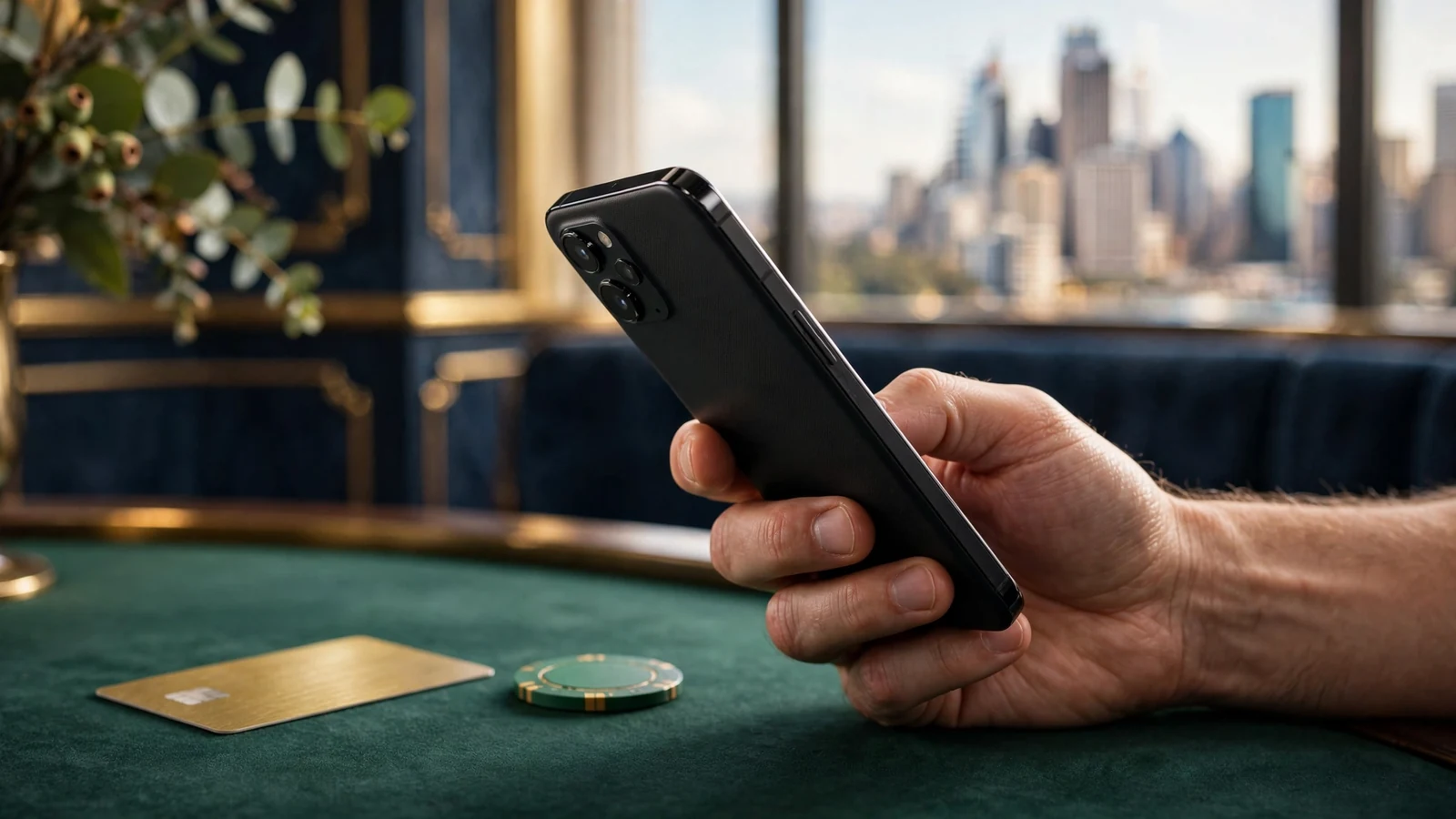
“Pay by phone” can describe two quite different things. In the strict sense, it means charging a purchase to your mobile account or phone bill. A mobile banking payment is different: you use your phone to access your bank and authorise a transfer from your bank account. The screen is a phone screen in both cases; the payment route is not.
That distinction matters when you see a claim about a casino accepting phone payments. A page may use “pay by phone” loosely to mean a payment made on a phone, rather than a charge added to your carrier bill. Unless the method is described clearly, you cannot tell which one is meant. And a mention of mobile banking does not establish that a phone-bill payment is accepted.
There is a separate legal point for readers in Australia. Under the Interactive Gambling Act 2001, operators cannot provide real-money online casino games, including pokies, to people physically located here. So claims promoting real-money online casinos to Australians should not be treated as an invitation to deposit. The payment terminology can still be confusing, but it does not change the legal position.
If you’re looking at pay-by-phone casinos in Australia for 2026, use this list as a starting point and check each site’s available deposit methods before signing up. The details below highlight only the information available for each operator.
Roby Casino
Roby Casino is listed with a Curacao eGaming license held by Roby Games Ltd.
Wild Tokyo
Wild Tokyo lists a minimum deposit of A$10. Its stated payout times are 30–60 minutes for crypto and 1–5 days for fiat.
Playfina Casino
Playfina Casino is licensed by Curacao eGaming through Hollycorn N.V., which has held the license since 2017. Its minimum deposit is A$20–30, depending on the offer.
Kingmaker
Kingmaker lists a minimum deposit of A$30. Its stated payout times are about 90 minutes for crypto and 1–5 days for fiat.
MrPacho
MrPacho lists a minimum deposit of A$30. Its stated payout times are 30–120 minutes for crypto and 24–72 hours for fiat.
JustCasino
JustCasino is listed as licensed by the Curacao Gaming Control Board.
Thor Casino
Thor Casino is licensed in Curacao by Antillephone N.V. (Versus Odds B.V.) and lists a minimum deposit of EUR 20.
SkyCrown
SkyCrown is licensed by the Tobique Gaming Commission and lists a minimum deposit of A$30. Its stated payout times are about 10–15 minutes for crypto and 1–5 days for fiat.
LuckyVibe
LuckyVibe is listed with a Curacao Gaming Control Board license, OGL/2023/176/0095, held by Hollycorn N.V.
Uptown Pokies
Uptown Pokies has operated since 2017 under a Curacao license and lists a minimum deposit of A$20.
PayID is an Australian payment service provided through the New Payments Platform (NPP). It lets people send and receive money using an identifier such as a mobile number or email address. The identifier helps direct a payment; it does not mean the amount is charged to the phone account linked to that number.
When PayID is used through a banking app, money moves from the bank account. PayID transactions settle in real time through the NPP. That makes it a phone-enabled bank payment, not a carrier-billed purchase. A mobile number can be the PayID identifier, but that does not turn the payment into a mobile-phone-bill transaction. Small distinction, important one.
This is why PayID should be described as an alternative payment route, not as proof that a service accepts “pay by phone” in the phone-bill sense. The wording on a payment page should identify the actual method. If it only says “mobile payment,” that phrase alone does not tell you whether it means a phone bill, a banking app, or simply a page designed to work on a handset.
The same caution applies to lists labelled as phone-payment casinos, including claims about new or top options. A label is not evidence of how a transaction works, and ranking language does not make a payment method clearer. I would separate the two questions: does the phrase mean a carrier charge, or does it mean a bank payment made using a phone? They are not interchangeable.
 Solana Casino Comparison Australia: Deposits and CashoutsLearn how SOL deposits and withdrawals work, what to check before comparing casinos, and how wagering rules, AUD conversion and changing SOL…
 Casinos That Accept Litecoin in Australia: What to CheckThis guide separates claims from evidence, showing what casino pages can establish about Litecoin support, payment conditions and Australian access.
For Australians, the legal context comes first: real-money online casino services are prohibited for operators serving people here. PayID’s presence in the Australian banking system does not validate a casino claim or make such a service lawful. It is simply a payment service with a clear banking function.
So, when you encounter “pay by phone,” read it literally and look for the named payment route rather than assuming that your phone bill is involved. PayID means a payment through the banking system using an identifier. It does not mean a carrier will add the amount to your monthly bill. No guesswork needed.
PayID is handled through your bank’s app, not by adding a charge to your mobile phone bill. In a payment flow that offers PayID, the basic sequence is to select that option, enter an amount, then confirm the transfer in the banking app. The phone is simply the device you use to move between the payment screen and your bank.
There is an important Australian legal point before getting into the mechanics: operators cannot legally provide real-money online casino games to people in Australia. That includes online pokies and other casino-style games. A checkout showing a payment option does not change that position, and a smooth-looking mobile payment screen is not proof that a service is lawful.
Legal Warning
Under the Interactive Gambling Act 2001, operators cannot legally provide real-money online casino games, including pokies, to people physically located in Australia.
If you encounter a PayID payment request, treat the recipient and payment details with care. A payment reference is not just a spare note field. Some casino payment systems rely on the player ID or username in that reference to match a transfer to an account. If the required detail is left out or entered incorrectly, the payment may not be credited automatically. It can sit pending until support staff handle it manually.
That is the easy mistake to make on a phone: moving quickly through the bank confirmation and assuming the payment description will take care of itself. It may not. Before confirming any transfer, read the payment instructions on the screen and check whether they specify a player ID or username for the reference. If they do, copy it accurately into the reference field rather than relying on memory or leaving it blank. A payment can reach the recipient while still being difficult to match to the intended account.
The practical order is straightforward: choose PayID in the payment interface, enter the requested amount, review any reference instructions, and then open or switch to your banking app to confirm the payment. The exact screen layout depends on the bank and the payment flow, so do not assume every app uses the same labels. Look for the field that carries the payment description or reference, and make sure the information required by the recipient is there before you approve anything.
 Casinos That Accept CashToCode in AustraliaLearn how to verify whether CashToCode is selectable for an Australian account, and why deposit availability does not establish a matching withdrawal…
 Casinos That Accept Neteller in Australia: Key ChecksLearn how to assess Neteller availability and terms. The Interactive Gambling Act 2001 bars operators from offering real-money online casino games to…
Keep the recipient details and the reference separate in your mind. The recipient identifies where the money is going; the reference can help identify whose payment it is. A correct amount alone may not resolve a missing account identifier. Nor should you assume that a payment provider or bank can infer the intended account from your name. If you are unsure what belongs in the reference field, stop and seek clarification rather than guessing.
After confirming through the banking app, keep the payment confirmation available. If an expected credit does not appear, check the reference you entered and contact the relevant support channel with the transaction information. A missing player ID or username can mean manual processing is needed, so a delay does not necessarily mean the payment has vanished. Still, avoid sending a second payment simply because the first one has not appeared; first establish what happened to the original transfer.
A phone makes this sequence easy to rush. I would pause at the reference field, read it twice, and only then confirm in the bank app. That small check is more useful than tapping through and hoping the system joins the dots.
The key distinction is between making a payment on a phone and paying through a phone bill. PayID uses your banking app to confirm a transfer; it is not a mobile carrier billing charge. And while the steps describe how a PayID payment interface works, they should not be read as an endorsement of using an online casino in Australia. The legal restriction applies to the operator’s provision of real-money casino games, regardless of whether its payment page is designed for a desktop or a mobile screen.
PayID Deposit Steps
Selection
Choose PayID in the payment interface and enter the requested amount.
Reference Check
Review the payment instructions and accurately copy the required player ID or username into the reference field.
Bank Confirmation
Open or switch to your banking app and confirm the transfer to the recipient.
Before looking at amounts, keep the legal position in view: under Australia’s Interactive Gambling Act 2001, operators cannot provide real-money online casino games to people physically in Australia. The figures below describe payment limits and deposit settings that may be displayed by offshore sites; they are not a recommendation to use one or a suggestion that doing so is lawful.
PayID deposit minimums are set by the site, not by your bank’s PayID limit. A displayed minimum commonly falls between AUD 10 and AUD 20. Some sites accept as little as AUD 5 through bank transfer, but that is a different payment route; it does not mean the PayID minimum is AUD 5. Check which method is selected before treating a figure on the payment screen as relevant to your transfer.
That distinction matters when you are comparing what a site says it accepts. A minimum is the smallest deposit the site says it will process through a particular method. It is not the amount your bank will let you send, and a low minimum does not establish that the site is legitimate or that it may lawfully offer casino games to Australians. Two separate checks, not one.
PayID transaction limits are set by the bank holding your account, and they differ between banks. Most major Australian banks allow PayID payments of AUD 1,000 to AUD 5,000 per transaction, with daily caps ranging from AUD 10,000 to AUD 20,000. Your own limit may be lower or otherwise different, so check it in your banking app or with your bank rather than relying on a broad market range.
 Casinos That Accept POLi in Australia: What to CheckLearn why a POLi mention does not confirm cashier availability, what to verify with an operator, and how Australian law treats real-money…
 Bitcoin Casinos in Australia: Deposits and PayoutsLearn how Bitcoin casino deposits move from wallet to account, what to check in bonus terms and payouts, and why one confirmation…
A per-transaction limit and a daily limit are not interchangeable. The first applies to an individual payment; the second is the total permitted across a day. If a payment is above your available limit, do not assume that repeatedly splitting it will solve the problem. Your bank’s settings and payment controls govern what can be sent. If the limit is unclear, ask the bank before taking any action.
I would also keep the site’s stated minimum separate from the bank’s maximum. They answer different questions: one is the smallest amount the payment page says it will accept, the other is the most your bank permits under its settings. Neither tells you whether a transfer is a sensible decision.
If you are reviewing a payment screen, check the recipient name shown for the PayID against the details supplied by the site. Do not proceed if the name is unexpected or does not match what you were told to expect. A familiar-looking logo or page is not a substitute for checking the actual recipient displayed in your banking app.
Read the payment reference as well. Where a site requires your player ID or username in that field, leaving it out or entering it incorrectly can prevent automatic crediting and leave the payment pending for manual handling. Check the reference carefully before confirming; do not add personal details that the payment instructions do not request. A reference is there to identify the payment, not to prove that the recipient is trustworthy.
If the name or reference differs from the instructions, stop and resolve the discrepancy through your bank or the relevant service’s verified support channel. Do not send a second payment just because the first has not appeared on a screen. That can leave you with two transfers to untangle rather than one.
A high bank limit is permission within your account settings, not a reason to use it. A small stated minimum is no assurance about how a site handles funds. Before making any decision, consider whether the payment is lawful and whether the recipient and payment details are independently verifiable. If those points are unclear, do not send money.
The practical check is simple: distinguish PayID from bank transfer, compare the site’s stated minimum with the selected method, confirm your bank’s own limit, and verify both the recipient name and required reference. Then stop if anything does not line up. A payment screen can show an amount; it cannot settle the legal or trust questions for you.
A deposit bonus can make an offer look larger than the money you actually get to keep. The headline is the least useful part. If you come across terms for a pay-by-phone casino deposit bonus, read the rules attached to it before accepting anything—and do not treat the offer as proof that a payment method is available or that the service may legally be provided in Australia.
Australian law prohibits operators from providing real-money online casino games to people physically in Australia. That includes slots and other casino-style games. So this is a guide to understanding promotion wording, not a recommendation to use an online casino or a claim that any particular bonus is available.
 Casinos That Accept PayPal in Australia: What to CheckLearn why search labels do not confirm PayPal availability or Australian access, and how to assess cashier details, withdrawal routes and bonus…
 Ethereum Casinos in Australia: Payment EvidenceLearn what general claims about crypto payment speed and fees can—and cannot—confirm about ETH casino support, deposits and withdrawals.
Wagering requirements describe how much qualifying play is required before bonus funds, or winnings linked to them, can be withdrawn. Check what the calculation is based on: the bonus, your deposit, or a combined amount. Those are not interchangeable, and a large-sounding bonus can come with a substantial play-through condition.
Look for the exact point at which the requirement is considered complete and which balance it applies to. If the wording is vague about whether winnings are restricted while the condition remains active, do not assume the most favourable interpretation. Clear terms matter more than a generous headline.
A maximum bet condition can limit how much you may stake while a promotion is active. Exceeding it may affect eligibility or the winnings attached to the offer, depending on the written rules. Check when the limit applies, not just the amount.
Game weighting tells you whether different games contribute equally towards the requirement. Some terms may exclude certain games or count them less. That can change how much qualifying play is needed in practice. A promotion described alongside online slots does not establish that every game contributes equally, or that a particular game is included. Read the exclusions and definitions rather than relying on a banner or short summary.
Promotions can have a deadline for completing wagering or using bonus funds. Check when that period starts, what happens when it ends, and whether unused funds or related winnings are removed. Do not infer a deadline from an advertisement if the full terms set out a different one.
Bonus Details
Always check for a maximum bet condition and game weighting, as these can limit your eligibility or change how much qualifying play is needed.
A maximum cash-out condition can also limit what may be withdrawn from bonus play. Find out whether the cap applies to bonus winnings, the total balance, or another defined amount. If the wording leaves that unclear, the practical value of the offer is unclear too.
Before accepting, read the full terms together: wagering calculation, maximum bet, game weighting, deadline and cash-out cap. If any condition is missing or difficult to interpret, treat that as a reason to pause, not as a detail to sort out later. The fine print is the offer.
“No wagering” sounds simple: a promotion appears to have no play-through requirement before winnings can be withdrawn. But the label alone does not tell you what the offer actually allows. Read the full terms, not just the banner or a short description.
Check whether the offer is a cash bonus or restricted promotional credit. Find out what can be withdrawn, whether winnings are capped, and whether a minimum withdrawal amount or other conditions apply. A promotion described as no-wagering does not automatically mean every credited amount is cash you can take out without restriction.
A no-deposit offer has a separate catch: you may not need to fund an account to receive it, but that does not make the credit unrestricted. Look for eligibility rules, any account or identity checks, the games or actions that qualify, and the deadline for using the offer. Confirm what happens if you do not meet a condition or miss that deadline. If the terms are vague, contradictory or hard to find, do not treat the headline as a promise.
For either type, check the maximum stake allowed while an offer is active, which games count, and whether a cash-out cap applies. These details can change the practical value of a promotion. I would also check whether accepting it affects other bonuses or withdrawals; terms may set conditions beyond the headline claim. Keep a copy of the rules shown when the offer is presented, rather than relying on a changing banner.
A phone-bill payment method, or a payment made on a phone, does not establish that an offer is genuine or that it can be claimed. Payment method and bonus terms are separate matters. Nor does a “no wagering” label make an online casino lawful in Australia.
The legal position matters here: under the Interactive Gambling Act 2001, operators are prohibited from providing real-money online casino games, including slots, to people physically in Australia. So treat claims about no-wagering or no-deposit casino promotions with particular care; this is not a recommendation to seek or accept one. If you have already encountered a promotion, do not send money or personal details based on a headline. Read the conditions and consider whether engaging with it is appropriate at all.
A clean headline is not the whole deal. The small print is the deal.
A phone-bill payment means a charge placed on your mobile account or prepaid balance. It is not the same as opening a banking app on your phone and sending a PayID payment. Seeing “mobile”, “phone” or “instant” in a payment description does not prove that the cost will appear on your phone bill.
I would treat claims about phone-bill casino deposits, including claims that they work without a particular billing provider, as unverified unless the payment terms clearly explain who processes the charge and how it appears on your account. The same goes for claims about phone-bill funding for real-money casino games, bingo or pokies. A payment label alone cannot establish that a service is available, lawful or connected to a particular game.
There is a more important point for anyone in Australia: under the Interactive Gambling Act 2001, operators cannot legally provide real-money online casino games to people physically in Australia. That includes online slots, poker and table games. So a page presenting phone-bill payments as a way to play real-money casino games here is not something I’d treat as a normal local payment option.
BetStop references need care, too. I can’t verify from a website’s wording whether it is covered by, or outside, any safeguard. Don’t read a claim such as “not on BetStop” as proof of safety, legality or permission to gamble. And if you have self-excluded or are trying to keep a block in place, looking for a site or payment route that might get around it is not a safe next step. Step away from the offer instead.
What can be checked? Read the payment terms for the actual funding method, and distinguish a phone-bill charge from PayID. PayID is sent through your banking app using the New Payments Platform; it is not a charge added to your mobile bill. That confirmed distinction does not establish that a casino accepts phone-bill payments.
If gambling is causing distress, Gambling Help Online is a support service in Australia. Seeking help is a better move than testing whether a site’s claims about billing or BetStop are true. A reassuring label is not a safeguard.
Seeing a payment option on a casino page tells you something about how a transaction might be handled. It does not confirm which games the site offers, whether a particular game is available to you, or whether the site is entitled to provide those games in Australia. Payments and game access are separate claims; one does not prove the other.
That matters when a page pairs a phone-related payment label with promises about pokies or other casino games. The label is not a catalogue. It does not tell you what titles are available, whether access depends on your location or account, or whether a game can be played after a deposit. A payment method alone cannot answer those questions.
The same goes for a claimed bonus. A payment option does not establish that a bonus exists, that it applies to a game, or that you can use it. Read promotion terms separately, rather than treating a deposit route as evidence of an offer. No shortcut there.
Attention: A payment method logo or deposit button is not a game list and does not prove that a particular game is accessible or lawful in Australia.
For Australians, there is a more basic point before any discussion of access: the Interactive Gambling Act 2001 prohibits operators from supplying real-money online casino games to people located in Australia. That includes pokies and other casino-style games. A site’s payment page, game imagery or description cannot change that legal position, and a payment method is not proof that a service is permitted.
I would keep the checks distinct: a payment claim concerns the transaction; a game claim concerns what is offered; and neither establishes that real-money casino play is lawful for someone in Australia. If a page bundles all three together as though one confirms the others, treat the claims with care. Don’t infer access from a deposit button.
This is especially worth remembering when a page uses broad wording such as “casino games” or “slots” beside a payment logo. Those labels can create an impression of a complete, working offer without showing what is actually accessible or whether the service may be provided here. The responsible conclusion is not that a particular game will work after you pay. It is that the payment information, by itself, cannot tell you.
Keep the distinction plain: payment method is not a game list, and a game list is not evidence of lawful access in Australia.
A site’s international branding, foreign licence badge or Australian-facing page does not establish that its real-money casino service can lawfully be offered to people in Australia. The Interactive Gambling Act 2001 prohibits operators from providing online casino games, including pokies, to customers physically located here. A claim that a service is based overseas does not change that.
Treat claims about phone-bill deposits with the same care. A page may use “pay by phone” to describe different things, and a payment logo or promotional line does not prove that a phone-bill charge is available, works for Australian customers or can be used for a particular game. Nor does a payment option establish that the site’s casino service is lawful here. These are separate claims; one does not validate the other.
I would be wary of a page that leans on a foreign licence as if it settled the Australian question, or presents access as assured. Offshore casino services are actively blocked and enforced against in Australia. Don’t read an accessible page, a working link or a payment instruction as permission or protection. The legal restriction is on operators, and players do not bear a fine or criminal prosecution simply for playing at an offshore casino without a local licence.
That still isn’t a reason to treat a payment claim as reliable. Look for clear, consistent wording about what the payment actually does, who receives it and what happens if a transaction is not credited. If the explanation is vague, changes between pages or bundles phone payments with unrelated banking options, don’t assume the distinction away. A polished page is not proof.
The same applies to claims about sites associated with Curaçao or services presented in German. A jurisdiction label or another language tells you nothing by itself about whether phone-bill charging is available to Australians, and it cannot override the Australian legal position. I would not rely on broad claims about “top” sites or mobile slots without specific, verifiable details—and those details do not make an Australian online casino service lawful. No badge fixes that.
International branding or a foreign licence badge (such as from Curaçao) does not override the Interactive Gambling Act 2001 or make real-money casino services lawful for people in Australia.
A card logo on a payment page does not make every claimed use lawful or available in Australia. Visa and Mastercard are widely accepted for deposits in some gambling contexts, but Australian rules prohibit operators from taking credit-card payments for online gambling services. Real-money online casino games are also prohibited for operators serving people in Australia. Treat a claim that a credit card can fund an online casino account here with caution; it is not a route to rely on.
Bank transfers are a separate payment method, not a phone-bill charge. A bank-transfer deposit may require the casino’s business name, account number and bank name, with international banking codes sometimes requested as well. Transfers can be arranged through a bank or online, but a deposit may take up to seven business days to appear and may carry charges. Those details do not change the legal position on online casino services in Australia.
Getting money out is a different process from funding an account. For a bank-transfer withdrawal, you may be asked for your bank details and identity documents. Complete KYC verification before requesting a first withdrawal where applicable; unresolved checks can hold up processing. Card withdrawals are not guaranteed: a specialist review describes them as slower than deposits or unavailable, depending on the payment processor.
Timing figures should be treated as estimates, not promises. A specialist payment review gives a range of one to five business days for bank-transfer and card withdrawals after approval. The operator’s own review can add time before funds are released, so a payment method’s advertised speed is not the whole story. PayID and some e-wallet or cryptocurrency withdrawals may arrive within minutes to hours after approval, but availability depends on the service and operator. None of these options makes an Australian online casino offering lawful.
If you see a page promising credit-card funding, quick cash-outs or easy bank transfers for an online casino aimed at Australians, pause rather than sending money or identity documents. Payment claims are not proof that the service can lawfully be provided here. Check what the claim actually covers, and do not assume that a deposit route will also be available for withdrawals. A tidy payment page proves very little.
Free spins and slot credits can sound like a way to try a promotion without making a fresh deposit, but the label alone tells you little about what you can actually use or keep. An offer may come with conditions that change the value of the credit, so read the terms before opting in.
Check whether the spins or credits apply to particular games, whether winnings must meet wagering requirements, and whether there is a maximum bet while an offer is active. Look for an expiry deadline and any cap on cash-outs. Those details determine what happens after a win; the headline amount does not.
The payment wording can be just as easy to misread. A mention of phone payments does not, by itself, show that a promotion is available, that it is tied to a phone-bill charge, or that it can be used with every payment method. Treat each claim as something to verify in the offer terms, not as a promise.
I would also check what happens if you deposit while an offer is active: whether the promotion is optional, how to decline it, and whether accepting it changes withdrawal conditions. Keep a copy of the terms shown when you opt in. Promotions can be revised, and a clear record helps if the wording later becomes disputed.
If the conditions are hard to find or unclear, leave the offer alone. Free is a headline, not a set of terms.
PayID deposit minimums commonly start at AUD 10–20. Your bank sets PayID transaction limits; major Australian banks commonly allow AUD 1,000–5,000 per transaction, with daily limits of AUD 10,000–20,000.
PayID withdrawals are supported by some casinos, but real-money online casino operators cannot legally provide their services to people in Australia.
Some casinos offer PayID withdrawals, but operators cannot legally provide real-money online casino games to people in Australia.
For PayID, casino review and approval can take around 2–6 hours for verified accounts; after approval, the payment may arrive within minutes to hours. Other methods, such as bank transfers and cards, often take one to five business days.
PayID casino deposits commonly start at AUD 10–20.