
Winshark Payment Methods
 Available in US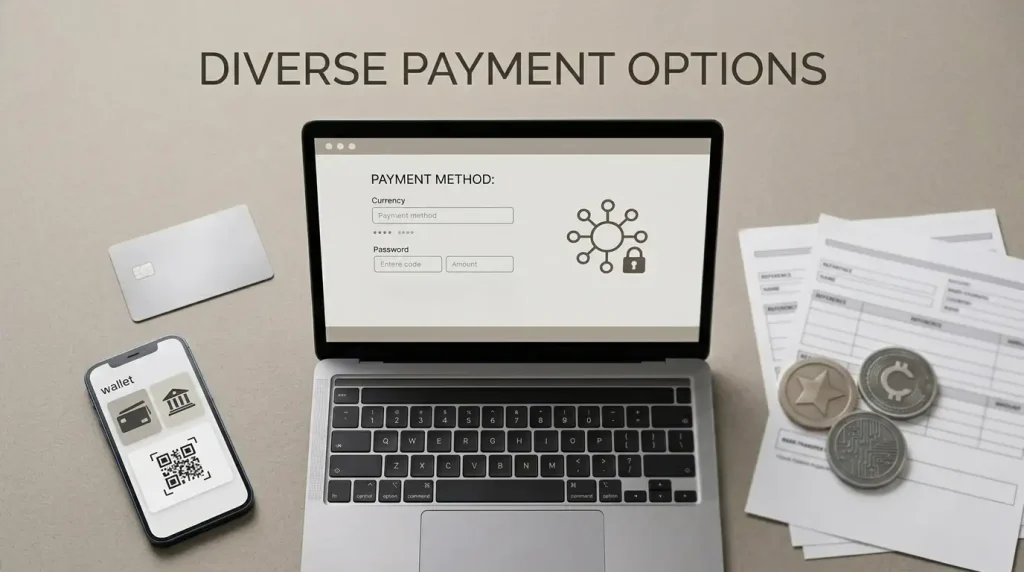
Winshark uses a hybrid cashier model, combining conventional payment rails with cryptocurrencies. The platform-level catalogue includes Mastercard, bank transfer, Skrill, Neteller, MiFinity, Paysafecard/Paysafe Card, Rapid Transfer, Revolut/CASHlib and crypto assets including BTC, ETH, USDT, LTC, BCH and ADA. AUD also appears in currency listings. The useful distinction is between the method category, the account currency and the transfer mechanics attached to each route.
Table of Contents
- Crypto payments add price and transfer risk
- Cards, wallets, bank rails and crypto share the cashier mix
- AUD appears in the currency list and payment-route fees stay separate
- Use method type, currency and cashout rules as separate checks
- Questions about Winshark payment methods
- The payment catalogue is broad, while cashout rules need their own check
Crypto payments add price and transfer risk
Crypto adds two risks that do not exist in the same form with an ordinary card or bank transfer. First, the value of a coin can move between acquisition, deposit and later withdrawal. Second, blockchain transfers are generally irreversible once sent to the wrong address or through an incompatible route. Those mechanics sit outside the casino account itself, so checking the destination address and selected network is part of the payment decision.
Winshark’s payment catalogue includes BTC, ETH, USDT, LTC, BCH and ADA. The relevant network is the one presented in the payment dialog at the time of a transfer, because network support can differ by asset and transaction route. A coin ticker alone is not enough to determine whether a particular chain is supported.
Stable-value assets such as USDT can reduce exposure to the price movement of a volatile coin, but they do not remove network or transfer risk. A token sent over an unsupported chain can create a recovery problem even if the token’s market price has barely moved. Conversely, BTC or ETH can introduce both transfer mechanics and price movement between the point at which the asset is obtained and the point at which a casino balance is later converted or withdrawn.
A simple scenario shows the distinction. If A$500 worth of a volatile coin loses 8% of its fiat value before other costs, the value change is A$40 before any network charge is considered. A network fee then affects the amount separately. The calculation is illustrative rather than a Winshark rate or forecast, but it shows why “no casino fee” and “no payment cost” are not the same statement.
For practical record-keeping, retain the transaction hash, destination address, selected network and the amount shown before confirming a crypto transfer. Those details are more useful in a payment query than the casino balance alone because they identify the on-chain transaction. The withdrawals guide deals separately with cashout limits, route-specific processing windows and verification at withdrawal.
Cards, wallets, bank rails and crypto share the cashier mix
The fiat side of Winshark’s catalogue covers several different payment families. Mastercard is a card rail; Skrill, Neteller and MiFinity are digital-wallet services; bank transfer and Rapid Transfer use bank-based routes; Paysafecard/Paysafe Card and CASHlib sit in the prepaid or voucher-style category; Revolut can operate as an account and payment route depending on the transaction. Treating them as one generic “fiat” method hides practical differences in settlement, issuer controls and withdrawal compatibility.
A wallet can separate the casino from a primary bank card and may support faster movement within the wallet ecosystem, while a bank transfer creates a conventional bank-to-bank trail. A prepaid method can limit the amount exposed from a main account, but prepaid deposit support does not automatically imply that the same route accepts withdrawals. The cashier’s withdrawal options therefore need to be checked independently from its deposit list.
| Coin | Network | Min Dep | Min WD | Speed | Fee |
|---|---|---|---|---|---|
| BTC | In the payment dialog | — | — | — | See fee note |
| ETH | In the payment dialog | — | — | — | See fee note |
| USDT | In the payment dialog | — | — | — | See fee note |
| LTC | In the payment dialog | — | — | — | See fee note |
| BCH | In the payment dialog | — | — | — | See fee note |
| ADA | In the payment dialog | — | — | — | See fee note |
Winshark’s casino-side fee is 0 for deposits and withdrawals. That describes the casino-side charge, not every cost around a transfer. A crypto network can require a miner or validator fee, a bank can charge for a transfer, and a card or wallet provider can apply its own terms. The amount received can therefore differ from the casino’s own fee line.
Fiat methods form a separate set
- Card: Mastercard.
- Bank-based: bank transfer and Rapid Transfer.
- Wallets: Skrill, Neteller and MiFinity.
- Prepaid or cash-code style: Paysafecard/Paysafe Card and CASHlib.
- Multi-purpose financial app: Revolut.
The presence of these methods describes the platform-level catalogue. The transaction screen remains the practical place to match the chosen method with the direction of payment, account currency and amount. This matters especially for prepaid methods and wallets because a route that can fund an account is not automatically the route used to return money.
For ordinary record-keeping, the method name is only the first field to capture. A useful payment record also includes the amount debited, amount credited, currency, provider reference and any conversion or service charge shown before confirmation. With crypto, add the network and transaction hash. These details let a user reconcile a payment without treating the casino balance as the only record of the transfer.
AUD appears in the currency list and payment-route fees stay separate
AUD is listed among Winshark’s supported account or payment currencies. That can simplify balance reading for an Australian user because a fiat balance can be denominated in Australian dollars rather than constantly converted mentally from EUR or USD. Currency denomination, however, is only one layer of the transaction. The funding instrument can still operate in another currency or impose a conversion before the money reaches the casino balance.
A card issuer may perform currency conversion under its own exchange-rate rules. A wallet can hold multiple currency balances and choose one according to its internal settings. Crypto introduces a different sequence: the user acquires or already holds a coin, transfers the asset, and may later convert value again. Each step can produce a cost or value change even when the casino-side fee is 0.
This is why the fee question is best split into three parts. The first is the casino-side fee, which is listed as zero for deposits and withdrawals. The second is the payment-provider fee, such as a bank, card, wallet or exchange charge. The third is the crypto network cost when an on-chain transfer is involved. Keeping those layers separate makes it easier to reconcile the amount that left one account with the amount that arrived in another.
Currency conversion creates a fourth practical checkpoint even when it is not labelled as a fee. If an account is funded from a non-AUD card into an AUD-denominated balance, the conversion can be performed by the card issuer or another provider in the chain. The rate used can affect the effective cost of the deposit. The same issue can arise in reverse on withdrawal if the receiving account settles in a different currency.
The presence of AUD or a listed payment method does not make online casino access lawful in Australia. Australian online-casino legality is covered separately on the Licence page. On the payments side, the practical task is narrower: understand the route, currency and possible third-party costs attached to a transfer.
Use method type, currency and cashout rules as separate checks
A payment route that works smoothly for a deposit may be a poor guide to the eventual withdrawal route. Some payment systems are designed primarily for funding, while withdrawals may need to return through another supported channel. Winshark’s payment catalogue is broad, but the account-specific cashier decides which methods are actually presented for a particular transaction.
Start with the method type. Card, bank, wallet, prepaid and crypto routes have different operational characteristics. Then check the currency shown at the point of payment. If conversion occurs before the casino balance is credited, the exchange rate belongs to the provider performing that conversion. Finally, treat withdrawal rules as their own stage rather than assuming that a deposit method defines the cashout path.
- Match the payment route to the asset or currency you actually hold.
- For crypto, copy the address carefully and use the network displayed for the transaction.
- Record any provider fee or conversion shown before confirmation.
- Keep the receipt, transaction identifier or blockchain hash.
- Before a withdrawal, review the available cashout route and any account-verification request.
Verification is particularly relevant at the withdrawal stage. Winshark can require identity or payment checks during the cashout process. That means a clean payment record can reduce avoidable friction if the account holder later needs to show ownership of a card, wallet or transfer. The account guide explains the verification and support side, while the dedicated withdrawals page covers limits and timing in more detail.
Consistency matters here. A cardholder name, wallet ownership record and account identity should describe the same person when a payment check is requested. For a bank transfer, the sending-account reference can help connect the transfer to the casino account. For crypto, control of an address can be harder to demonstrate through conventional statements, which makes transaction records and exchange receipts more useful if verification later reaches the source of funds or payment ownership.
None of these steps guarantees a particular processing time. They are preparation for the account and payment checks that can arise around cashout. Timing and limits depend on the withdrawal stage, so they belong in the dedicated withdrawal analysis rather than being inferred from how quickly a deposit appears.
For crypto, an extra discipline is to distinguish the casino transaction from the market value of the coin. A successful transfer can still lose fiat value if the asset moves sharply, and an incorrect blockchain transfer can be irreversible. Those risks are mechanical consequences of the payment rail rather than evidence about casino performance.
Questions about Winshark payment methods
Does Winshark list AUD as a supported currency?
Yes. AUD is supported as an account or payment currency.
Which cryptocurrencies are listed for Winshark?
BTC, ETH, USDT, LTC, BCH and ADA are included in the platform-level payment catalogue.
Does Winshark charge deposit or withdrawal fees?
Winshark’s casino-side fee is 0 for deposits and withdrawals. Network, issuer, bank or payment-provider charges can still be separate.
Does a listed payment method mean it is lawful to use Winshark from Australia?
No. Payment-method or AUD support does not change the Australian prohibition on offering online casino services to people in Australia.
The payment catalogue is broad, while cashout rules need their own check
Winshark combines cards, bank-based routes, wallets, prepaid methods and several major cryptocurrencies, with AUD included in its currency list. That breadth gives users different ways to move value, but each route has its own currency, provider and transfer mechanics. Separate the casino-side fee from third-party costs, verify crypto networks before sending, and treat withdrawal limits, timing and verification as a distinct stage rather than an extension of the deposit screen.