Understand mobile access, payment options, offer conditions and the differences between free-play games and real-money play.
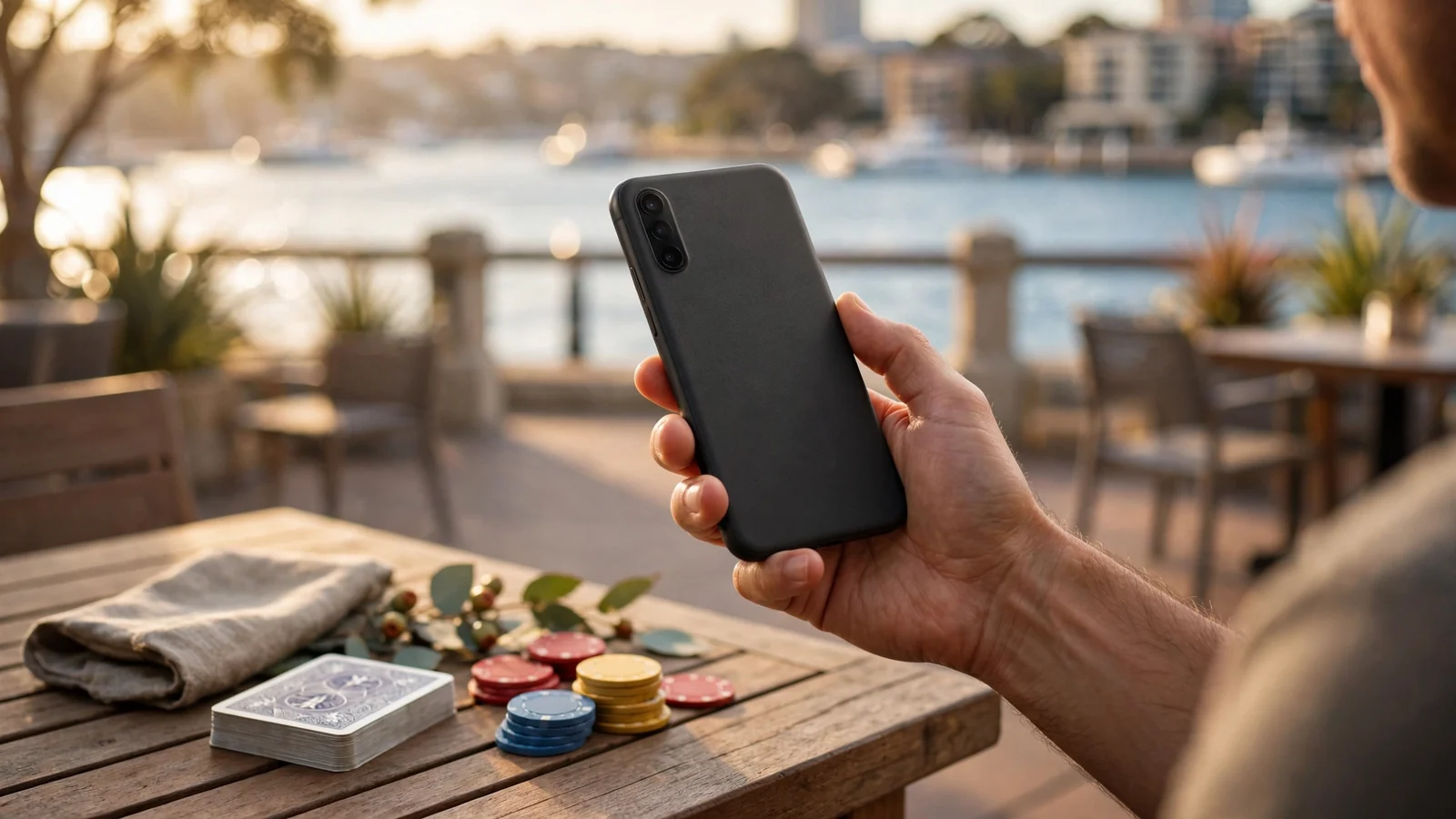
On a phone, access is usually less complicated than the label makes it sound. Most Australian punters reach an offshore casino through their mobile browser, opening the website much as they would on a computer. The account is generally the same one used on desktop, so there is no separate mobile profile to set up just because you have changed screens.
That browser-first approach is also why an app icon is not a reliable test of whether a site works on a phone. Casino apps are seldom available through the Australian versions of Google Play or Apple’s App Store. For many sites, the website itself is the ordinary route in; a native app is not the expected starting point.
With browser play, you visit the casino website in the browser already on your phone. There is no separate app to find in an app store. The site opens as a web page, and you sign in using your existing account. If you switch between phone and desktop, you are still using that account rather than creating a mobile-only one.
Choosing a mobile casino for use in Australia means looking beyond the headline and checking the details that are available. This list gives you a concise reference point for considering your options in 2026.
Roby Casino
Roby Casino is listed with a Curacao eGaming license held by Roby Games Ltd. This is the licensing detail available for your reference.
Wild Tokyo
Wild Tokyo lists a A$10 minimum deposit. Its stated payout times are 30–60 minutes for crypto and 1–5 days for fiat.
Playfina Casino
Playfina Casino is listed as licensed by Curacao eGaming through Hollycorn N.V., with the stated association dating to 2017. Its minimum deposit is A$20–30, depending on the offer.
Kingmaker
Kingmaker lists a A$30 minimum deposit. Its stated payout times are around 90 minutes for crypto and 1–5 days for fiat.
MrPacho
MrPacho lists a A$30 minimum deposit. Its stated payout times are 30–120 minutes for crypto and 24–72 hours for fiat.
JustCasino
JustCasino is listed with a Curacao Gaming Control Board license. That licensing information is the available point of reference for you.
Thor Casino
Thor Casino is listed as licensed by Curacao’s Antillephone N.V. through Versus Odds B.V. Its stated minimum deposit is EUR 20.
SkyCrown
SkyCrown is listed with a Tobique Gaming Commission license and a A$30 minimum deposit. Its stated payout times are around 10–15 minutes for crypto and 1–5 days for fiat.
LuckyVibe
LuckyVibe is listed with Curacao Gaming Control Board license OGL/2023/176/0095, held by Hollycorn N.V. This is the licensing detail available for your reference.
Uptown Pokies
Uptown Pokies is listed as operating since 2017 under a Curacao license. Its stated minimum deposit is A$20.
I’d start by checking how the site behaves in the browser you already use, rather than assuming an app is necessary. Browser access is the common format for Australian mobile casinos, and it avoids the extra step of installing a separate application. It also makes the distinction clear: you are opening a website, not downloading a native app from an official store.
The word “mobile” can be doing a lot of work in a casino’s description. It may simply mean the website can be viewed on a phone. That is different from having a native app designed and distributed through an app store. If you are trying to work out what a site actually offers, look for whether it opens in the browser or presents an option to add the site to your home screen.
A Progressive Web App, or PWA, is still tied to the casino’s website. It gives you a shortcut on your phone and can present the site in a way that feels more like using an app. It is not the same thing as downloading a standard native app from Google Play or Apple’s App Store.
If the website offers a PWA, the installation prompt may appear while you are visiting it. You can tap the option to install or add the site to your home screen, then confirm. The wording and appearance of the prompt can vary by phone and browser, so don’t assume every device will show exactly the same steps.
Once added, the shortcut gives you a direct way to open that website from your home screen. The important distinction is that the PWA is a website shortcut with an app-like presentation. It does not turn the casino into a different service, and it does not mean the site has a native app listed in an Australian app store.
For someone who prefers a less cluttered home screen, browser access may be enough. If you visit the same website often and want a direct icon, a PWA may be more convenient. That is a preference about how you open the site, not evidence that one format is safer or better. Check which format you are being offered before agreeing to install anything.
In Australia, casino apps are rarely found in the major app stores, so mobile browser access tends to be the default. Sites that accept Australian players commonly use browser play or a PWA instead of offering a native mobile app. That is the practical picture to expect when you look for an online casino to use on a phone: a website first, with an optional home-screen shortcut on some sites.
Be wary of treating a download prompt as proof that an app is official. Sideloaded casino apps—ones installed from outside the usual app stores—carry security risks, and their safety depends on the operator. If a site directs you to install a file directly, pause and consider whether you are comfortable with that risk. You do not need to sideload an app simply to use a website in your phone’s browser.
Sideloading Risks
Sideloaded casino apps installed from outside official stores carry security risks; their safety depends entirely on the operator.
A browser or PWA is the main access-format choice, then. The browser keeps things simple; the PWA adds a home-screen shortcut and an app-like feel. Neither label should do your thinking for you. Check what is actually being installed, and remember that an icon on your screen can be a shortcut to a website rather than a native app.
That’s the distinction.
A phone can make a casino game feel straightforward one minute and fiddly the next. I judge the mobile experience by the basics: whether the page responds when I tap, whether text stays readable without constant zooming, and whether the game remains usable when the screen is held the way I normally hold it. A polished-looking front page is not much help if the controls are cramped once play begins.
Before spending time in a game, look at how its buttons and information fit on your screen. Can you read the labels clearly? Are the main controls easy to distinguish, or are several buttons packed together? Check that menus open properly and that you can get back to the game without losing your place. These are small details, until they are not.
I also pay attention to how the game behaves after a tap. Does it acknowledge the action promptly, or does the screen appear frozen? Is the result clear, or does an animation keep you waiting without telling you what is happening? A brief pause can be a connection hiccup; repeated lag or controls that stop responding make the whole session harder to follow. Don’t keep tapping in frustration. You may not know whether the first tap registered.
A specialist review of mobile play identifies poor connections, limited phone memory, older browsers and too many background apps as common sources of trouble. That gives you a sensible first check when something goes wrong: see whether the connection is steady, close apps you are not using, and check that your browser is current. If the phone is short on available memory, other open tasks can leave less room for the game to run smoothly. Not glamorous, but often more useful than blaming the game immediately.
Notice whether the problem follows a pattern. If the page struggles across several games, the phone or connection may be the common factor. If one game alone misbehaves while the rest of the site remains responsive, that points to a narrower issue. Either way, refresh only when you are confident you will not interrupt an action in progress. A reset is not a diagnostic tool if you have no idea what the screen was doing.
Screen size matters for comfort as well as visibility. On a smaller display, text and controls can feel crowded; zooming may make one part easier to read while pushing another off-screen. Try the normal view first, and avoid assuming that a layout built for a desktop will feel natural in your hand. If you need to squint to see the information or keep shifting the phone to reach a control, that is a practical usability problem, not a test of patience.
Sound and animation are worth checking too. If audio is distracting or an effect makes the screen harder to follow, look for the game’s own controls rather than turning the whole phone into guesswork. Keep an eye on battery and heat during longer sessions; a phone that is already busy may feel less responsive. If performance gets worse as other apps remain open, close them and try again. Small fixes first.
The useful question is not whether mobile play looks impressive in a screenshot. It is whether the page stays legible and responds consistently on your actual phone, with your connection and browser. I prefer a clear, steady interface to one that piles on effects and makes every tap feel uncertain. Less fuss.
The legal line in Australia falls differently for the operator and the punter. Under the Interactive Gambling Act 2001, providing online casino-style games to people in Australia is prohibited. That covers real-money casino play, including familiar games such as poker, blackjack, roulette and pokies. The law is directed at the service being offered; it does not make an individual Australian player’s use of an offshore mobile casino a criminal offence.
That distinction matters, but it is not an endorsement or a sign that offshore services are locally regulated. A site being reachable on a phone does not make its casino games lawful for the operator to provide here. Nor does being based overseas change the Australian rule. For anyone comparing mobile casinos in Australia, the first thing to understand is that the legal position is not the same as it would be in a market where online casinos are permitted under a local licensing system.
The Australian Communications and Media Authority, or ACMA, works to restrict access to gambling services that breach the rules. It can direct internet service providers to block illegal gambling sites. As a result, an offshore site may become inaccessible from Australia, even if it was available previously. A failed page or sudden loss of access is not proof that the site has closed everywhere; it may reflect a block applied in Australia. Don’t treat that as a cue to find a workaround.
There is a practical gap between the operator-facing law and what a person sees on their screen. Offshore services may still present themselves to Australian visitors, while ACMA action can limit access. That can leave you with an unstable picture: a site’s own claims do not settle its legal status, and a working mobile page does not mean the service has approval to operate here. “Available” and “authorised” are different things.
Age is a separate, straightforward requirement. You must be at least 18 to register and gamble in Australia. A site’s registration screen may ask for your age, but the responsibility is not just a box to tick; do not use a gambling service if you are under 18.
If you are looking up an Australia mobile casino, keep these points distinct: the Act prohibits operators from supplying online casino games to people in the country; it does not make playing at an offshore casino illegal for the individual; and ACMA blocks access to illegal gambling sites. None of those points turns an offshore service into a locally approved one. The legal picture is easy to blur when a site loads normally on a phone. The distinction is the important bit.
Legal Distinction
While the Interactive Gambling Act 2001 prohibits operators from providing online casino games to Australians, using an offshore mobile casino is not a criminal offence for the individual player.
If you are checking how to pay from your phone, start with the cashier rather than assuming every method will appear. The payment options can differ between offshore casino sites, and a method shown in a general guide may not be available to you when you open an account.
A specialist review describes PayID as a deposit route that can arrive near-instantly and typically cost nothing to use. Treat that as a reported feature, not a guarantee for every transaction: the site’s cashier and payment instructions are the place to confirm what it currently accepts and whether any conditions apply. Check the recipient details carefully before approving a transfer. A payment sent to the wrong details is a poor way to begin.
Specialist reviews also list bank transfers through PayID or BPAY, cards, and cryptocurrency among possible mobile deposit routes, with processing times varying by method. That does not mean one option is available across the market. The site may show a different set of choices, and the time taken to appear in your account can depend on the route and its processing arrangements. Read the cashier’s instructions before you send funds, and keep the transaction confirmation until the balance updates.
POLi is not a current local payment option. Its Australian service ended in September 2023, so an old page that still presents POLi as a way to pay is out of date. If a site mentions it, look for a current explanation rather than treating the name as proof that the payment can be completed.
Cards can be familiar, but they are not a sure thing for gambling-related charges. A specialist review notes that some Australian banks may block or flag those transactions, which can leave a deposit declined. If that happens, do not keep retrying without checking with your bank and the payment instructions. A declined charge does not necessarily mean you entered the details incorrectly.
Searches for PayPal and mobile casino payments can also create an expectation that the service will be in the cashier. Check the live payment menu before registering or attempting to pay, and do not rely on an old comparison page to settle the question.
A mobile casino app does not change the basic checks. Whether you are using a phone browser or an app-like shortcut, open the cashier and confirm the method, any stated processing time, and any charges before authorising a payment. If the instructions are unclear, pause rather than guessing. A deposit route should be understandable before you use it.
A no-deposit offer may sound like a way to try a mobile casino without paying in first. Treat the label as a prompt to read the conditions, not as proof that you can withdraw anything without restrictions. The offer may come with wagering rules, a deadline or other eligibility conditions that change what you can do with any winnings.
Start with the wagering requirement. It sets how much qualifying play must be completed before a bonus or winnings become eligible for withdrawal. Check what amount the multiplier applies to: the bonus, the winnings, or a combined figure. Those are not interchangeable. A specialist review of casino offers puts welcome-bonus wagering requirements in the 30x–50x range, but that figure should not be assumed to apply to a no-deposit promotion. Read the terms attached to the specific offer.
Next, find the expiry date and what happens when time runs out. A specialist review reports that many bonuses have a 7–10-day clearance window; if the deadline is missed, the bonus can be lost. That is not a promise that every offer follows the same schedule. Look for when the clock starts, whether it applies to the bonus or the wagering task, and whether the terms say unfinished play is forfeited.
Check the minimum deposit condition, too. “No deposit” may describe how an offer is first accessed, while another condition may still require a deposit before winnings can be withdrawn. If the terms are unclear about whether a deposit is needed, or when, do not assume the most favourable interpretation. The minimum deposit, wagering requirement and time limit all affect whether an offer is worth engaging with.
Look for restrictions on eligible games and bets. A promotion may exclude particular games or count only some play towards its wagering requirement. Also check any cashout cap: it can limit the amount that may be withdrawn even after the requirements are met. These details matter more than a code or banner promising a free start. A mobile casino bonus code does not override the offer’s terms.
Before accepting anything, make sure you can find the full conditions and understand them on your phone screen. If the text is hidden, incomplete or contradictory, pause rather than relying on a short promotional message. Read the wagering requirements, game restrictions, expiry dates and cashout caps before claiming. No-deposit wording is not a substitute for clear terms.
A ranking can make a mobile casino look like a straightforward choice. It isn’t. A high position on a page does not tell you whether a site accepts people in your location, whether its rules suit you, or what happens if there is a dispute. I’d treat any comparison as a starting point, not a green light.
Any options presented for comparison are offshore and crypto-friendly. That describes the type of service, not an endorsement or a guarantee of safety. Before you deposit, confirm directly with the operator that it accepts customers physically located in Australia. A site’s home page may still load even when registration or play from your location is not allowed.
Look at the operator’s terms and the practical details that affect your account. Find the rules for identity checks, account closure, complaints and withdrawals before you hand over personal information or money. If you cannot locate those rules, or they read differently across pages, pause. A polished mobile layout does not make unclear terms clearer.
A stated licence is worth checking, but don’t mistake it for Australian approval. Operators that accept Australian customers may refer to jurisdictions such as Curaçao, the Malta Gaming Authority or Gibraltar. Those are offshore jurisdictions; their names do not mean an Australian government body supervises the service or can resolve a dispute for you. If an offshore casino refuses to pay winnings, there is no Australian government body you can turn to for a complaint.
VPN Usage
Using a VPN to bypass location restrictions may breach a site's terms, potentially leading to voided winnings or account closure.
Be careful with VPNs. Using one to get around a site’s location restrictions may breach its terms; the operator may void winnings or close your account. It is a poor workaround, not a dependable way to protect access.
The same caution applies to apps offered outside official app stores. A sideloaded casino app carries security risks, and its safety depends on the operator. Don’t install it simply because the site presents it as an easier way to play. Check who provides it and whether you are comfortable granting the requested access.
Before claiming any bonus, read the full terms, including wagering requirements, game restrictions, expiry dates and cashout caps. A headline offer tells you little about what you must do to withdraw winnings. If the conditions are hard to find or understand, leave the offer alone.
My test is plain: can you verify that your location is accepted, understand the rules, and identify what recourse exists if something goes wrong? If not, a “best” label won’t fill the gaps. No shortcut there.
A casino-style app on your phone can look familiar without involving real-money gambling. Social and free-play casino apps use virtual credits, so the key difference is what you are playing with—not the graphics, sounds or layout.
In Australia, these apps are available directly through the Google Play Store and Apple App Store. That is different from an app that offers real-money casino play. A listing in an official app store does not mean every casino-style service is the same, so check the app’s description and the way it explains its credits before you start.
Virtual credits are for play within the app. Treat them as part of the app experience, not as cash in an account. If you are choosing an app for casual play, check whether credits are described as virtual and whether the app’s terms explain their use clearly. If the wording leaves you unsure whether money is involved, pause and read the details rather than assuming the app is free simply because it is called “social” or “free-play”.
The distinction also matters when you compare mobile casino games. A familiar design does not tell you whether an app is free-play or real-money; the credit system does. Free-play apps can be used for entertainment with virtual credits, while real-money gambling involves putting money at risk. Those are different kinds of play, even when the phone screen makes them look alike.
I’d check the store listing before installing and the in-app description before playing. Look for a plain explanation of what the credits are, how they are used, and whether the app presents any purchases or other costs. Don’t infer the answer from a game’s appearance or from words such as “casino” and “free” in its title. Read what the app actually says.
For someone who wants a casual mobile game experience, a social app using virtual credits is the relevant category. You can find those apps through the usual Australian app stores, without mistaking that availability for approval of real-money casino services. Store access is a practical distinction, not a reason to assume that every similarly named app works the same way.
The simple check is this: identify whether the app uses virtual credits or money before you play. If you cannot tell from its description and terms, choose not to proceed until it is clear. Appearance can be convincing. The credit details matter more.
“Free” and “crypto” describe different things, even when they appear side by side in a casino listing. One is about the cost or format of play; the other is a way to move funds. Neither label, by itself, tells you what a site actually offers or what conditions apply.
When a page talks about free mobile pokies, it may mean games played with virtual credits rather than money. It may instead refer to a promotional incentive, such as a signup bonus. Those are not interchangeable: virtual credits are for play without a cash stake, while bonus credit is attached to an offer and may come with conditions. The word “free” does not establish that winnings can be withdrawn, or that a particular promotion is available to you.
Read the wording around the claim. Does it describe a free-play mode, promotional credit, or something else? If it is an offer, look for its eligibility rules and full terms before accepting it. A headline can make two very different arrangements sound much the same. Small print does the separating.
Crypto has nothing to do with whether play is free. A mobile crypto casino label points to cryptocurrency as a payment method, not a special kind of game or a no-cost account. A site may use crypto for deposits, withdrawals, or both; the label alone does not confirm which routes it supports. Nor does it tell you whether a game is free to play or uses real money.
The same distinction applies to PayID. Seeing PayID mentioned alongside pokies on mobile tells you that the page is referring to a payment route, not free play. Payment names and promotional wording often sit close together in a listing, but they answer different questions: how funds may be moved, versus whether a play mode or offer involves money.
I’d treat any combined claim—free play, a signup bonus and crypto payments—as three separate things to verify, not one package. Check what “free” refers to, whether the stated payment method is actually supported for the action you need, and whether the offer’s terms change what you can do with any credit. Don’t assume a label guarantees access, an available promotion, or cashable winnings.
A useful rule of thumb: “free” describes a claimed play arrangement; “crypto” describes a payment option. One does not prove the other.
Getting money out is a separate step from seeing a balance in your account. A withdrawal can be waiting for the casino to review it before the payment provider or bank processes it. Check the status shown in your account and the withdrawal rules before assuming a delay means something has gone wrong.
Processing times vary by method: e-wallet withdrawals can arrive within 24 hours after the casino’s pending period, while bank transfers may take up to five business days.
Timing depends on the route. A specialist review reports that e-wallet withdrawals can arrive within 24 hours after the casino’s pending period, while a bank transfer can take up to five business days. Treat these as reported timeframes, not a promise for every mobile casino platform: the operator’s processing queue and your bank can affect when funds arrive. If the stated window passes, contact support with the withdrawal reference and ask whether the request is still pending or has been sent.
Expect identity checks, particularly when you make your first withdrawal. The casino may ask for identification, such as a passport or driver’s licence, a selfie, and proof of your address. Submit clear, current documents through the account’s secure verification process, and make sure your registration details match them. If you leave verification until you request a payout, the review can hold things up.
Read the payment rules before choosing a method. Some casinos require a withdrawal to go back through the same method used for the deposit; others accept certain methods only for deposits. That can mean the option you used to fund the account is not available for cashing out. Confirm the available withdrawal routes and any account-name requirements first.
Limits deserve a look too. A specialist review describes some casinos as setting weekly or monthly withdrawal caps, with reported weekly limits ranging from $4,000 to $10,000. The actual cap depends on the operator’s rules, so check the cashier or terms rather than treating that range as universal. A limit may mean a large balance is paid in instalments instead of one transfer. Not ideal.
Keep a record of the request date, chosen method, status updates and support replies. If a withdrawal is delayed, those details make it easier to ask a precise question. Also check whether the casino has requested another document; a message asking for verification can be easy to miss on a phone. Don’t submit a second withdrawal request just to test the system unless support tells you to. You want a clear trail from request to payment, not a tangle of duplicate transactions.
A bonus headline tells you very little about what you would need to do before any winnings become withdrawable. The key is the wagering requirement: check what amount the multiplier applies to, then work out the total wagering attached to the offer. A specialist review describes requirements above 40x as steep; treat that as a point to scrutinise, not a universal dividing line.
The calculation matters because a large-looking offer can come with a demanding turnover condition. Minimum deposits and time limits also affect whether the deal is workable. If you would need to wager more than you can comfortably afford, or rush through play to meet a deadline, the bonus is not adding useful value. I’d rather see the terms plainly than be dazzled by the headline.
Expiry dates deserve the same attention. A specialist review notes that many bonuses have to be cleared within 7–10 days, with the bonus lost if the deadline passes. Check when the clock starts and whether the deadline applies to wagering, the bonus balance, or both. Don’t assume that an unfinished requirement simply waits for you.
Then look beyond the multiplier. The terms should say which games count, whether some games are excluded or contribute differently, and whether there is a cashout cap on winnings linked to the offer. A cap can limit what you may withdraw even after meeting the wagering requirement. Read the full conditions before claiming, including restrictions, expiry and any cashout limit—not just the short description beside a button.
That applies whether an offer is advertised as a mobile casino bonus, presented through a code, or labelled as a no-deposit deal. The label does not replace the terms, and a code does not make an unsuitable offer worthwhile. If cryptocurrency is mentioned, that describes a payment option, not a change to the bonus rules.
Keep a simple check in mind: what must be wagered, by when, on which games, and what could be withdrawn if you meet every condition? If any answer is unclear, pause before accepting. A bonus is optional. The conditions are not.
Yes. You can use social and free-play casino apps with virtual credits; these are available through Google Play and the Apple App Store.
No. You can usually play through your phone’s browser using your existing casino account; some sites also offer a PWA shortcut.
Browser play is the straightforward option because you can use the site without installing a separate app. A PWA can be more convenient if you want a home-screen shortcut.
Crypto and e-wallet withdrawals are typically processed in under 24 hours. E-wallet funds usually arrive within 24 hours after the casino’s pending period, though a first withdrawal may require identity checks.
No. Most Australian mobile casinos are accessed in a browser, and some offer a PWA that adds a website shortcut to your home screen.