
A seven-reel layout describes presentation, while RTP, rules and game versions provide separate details to check.
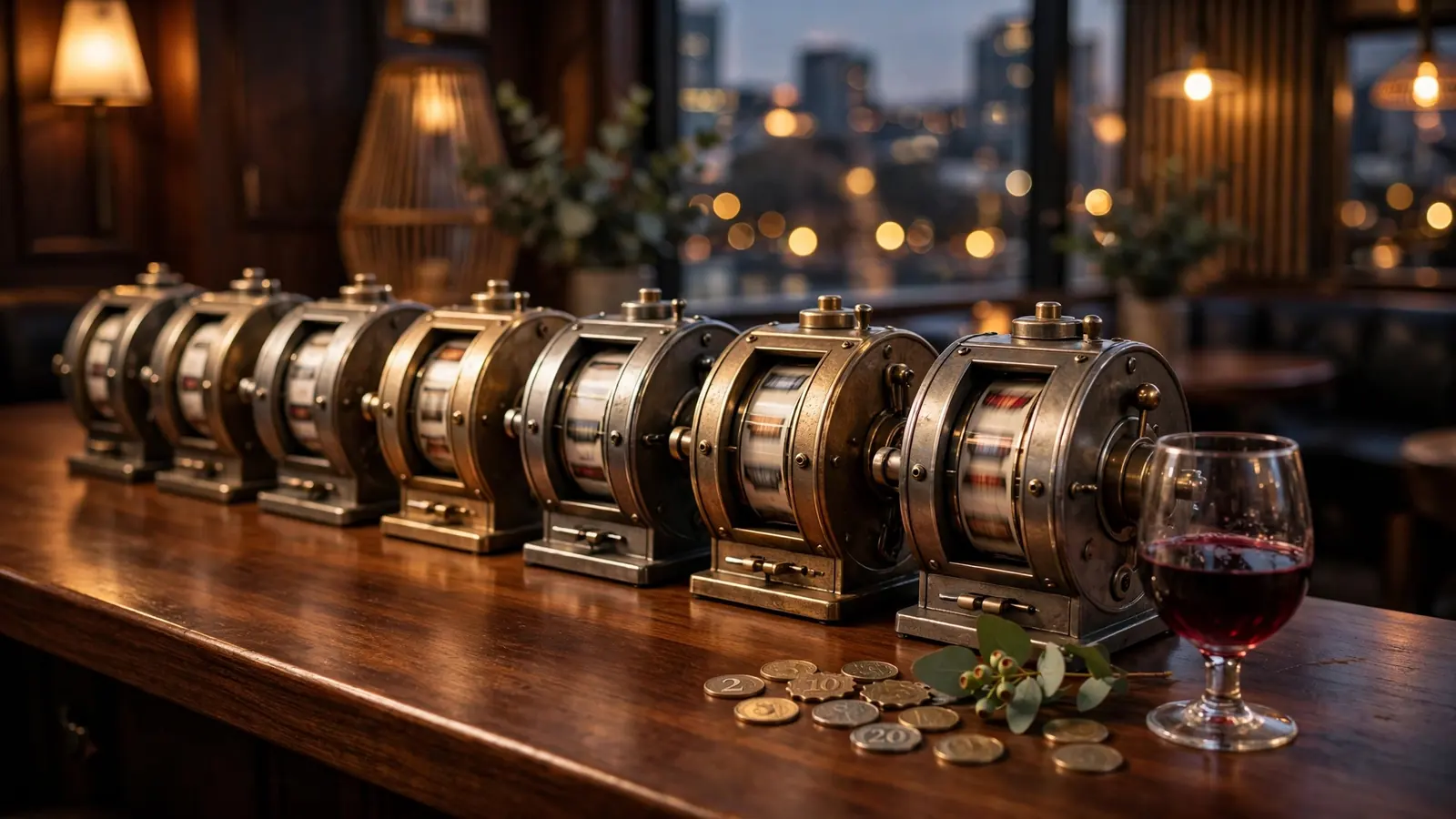
A seven-reel label is a description of a game’s layout: it tells you the game is presented with seven reels. That is useful when you have a particular style in mind, but it is not a score, a promise of frequent wins or a measure of how generous a game will be. The number alone cannot tell you what a spin might return.
That distinction matters when you are comparing games described as seven-reel slots. Reel count is one visible feature; performance depends on other information, including the game’s theoretical return to player, or RTP. A title with seven reels is not automatically better than one with fewer. I’d treat the label as a way to narrow the kind of game you want to inspect, then look at the rules before drawing conclusions.
The same goes for searches for free seven-reel games. Free play can let you get a feel for the interface, but the reel count still says nothing about the result of a future spin. Nor does a familiar-looking layout tell you whether a particular version has the RTP you expected. Those are separate details to verify.
If you’re looking for reel slots in Australia in 2026, check the details that matter to you before choosing where to play. This list gives you a concise reference to the available licensing, deposit and payout information for each operator.
Roby Casino
Roby Casino is listed with a Curacao eGaming license held by Roby Games Ltd.
Wild Tokyo
Wild Tokyo lists a A$10 minimum deposit and a Curacao license. Its stated payout times are 30–60 minutes for crypto and 1–5 days for fiat.
Playfina Casino
Playfina Casino is licensed by Curacao eGaming through Hollycorn N.V., which has held the license since 2017. Its minimum deposit is A$20–30, depending on the offer.
Kingmaker
Kingmaker lists a A$30 minimum deposit. Its stated payout times are around 90 minutes for crypto and 1–5 days for fiat.
MrPacho
MrPacho lists a A$30 minimum deposit, with stated payout times of 30–120 minutes for crypto and 24–72 hours for fiat.
JustCasino
JustCasino is listed with a Curacao Gaming Control Board license.
Thor Casino
Thor Casino is licensed in Curacao by Antillephone N.V. (Versus Odds B.V.). Its stated minimum deposit is EUR 20.
SkyCrown
SkyCrown is licensed by the Tobique Gaming Commission and lists a A$30 minimum deposit. Its stated payout times are around 10–15 minutes for crypto and 1–5 days for fiat.
LuckyVibe
LuckyVibe is listed with a Curacao Gaming Control Board license, OGL/2023/176/0095, held by Hollycorn N.V.
Uptown Pokies
Uptown Pokies is listed as operating since 2017 under a Curacao license. Its stated minimum deposit is A$20.
RTP is a statistical estimate of the share of wagers a game is designed to return across an enormous number of spins, potentially millions. It is not a forecast for your session. A higher RTP points to a theoretically better return over the long run than a lower one, but neither figure predicts what will happen in a short run of play. Long-run maths is not a personal promise.
You will generally find a game’s RTP in its rules or paytable. If you are comparing options, check that information rather than relying on the game’s name, artwork or reel count. A useful benchmark is 96% or higher, but the figure should still be read as a theoretical measure, not as a guarantee that you will get back a particular amount.
It helps to keep three questions apart: how many reels the game shows, what its rules say about possible outcomes, and what its RTP indicates over time. They are related only in the broad sense that they describe different parts of a slot. One does not answer the others. A seven-reel game can have an RTP you need to check, just as any other slot can.
 Five-Reel Slots in Australia: Features and RulesCompare Sweet Bonanza, Blood Suckers and classic five-reel slots, and check what the rules say. One reported version awards ten free spins…
 Pokies Tips and Tricks: What Actually MattersLearn why past spins cannot predict the next result, and how to assess bonuses, budgets, game odds and jackpot claims without treating…
I also wouldn’t use reel count to guess how often a game will pay. Each spin is generated by a Random Number Generator and stands on its own; earlier results do not make a later one due. A striking run on the screen is still just a run, not evidence that the next result has changed its odds. The reel label doesn’t alter that.
So when someone asks for the “best” seven-reel slots in Australia, the word best needs a measure behind it. If it means seven reels, that is a format preference. If it means a higher theoretical return, check the RTP shown in the game’s rules or paytable. If it means a more enjoyable theme or pace, those are personal preferences, not facts established by the number of reels. No ranking follows from the label alone.
It does not treat the count as proof of better returns or a shortcut to picking a winner. I’d start with the feature you came for, then check the information that actually speaks to the game’s theoretical return. The distinction is simple. The label is not the maths.
Sweet Bonanza often comes up in searches for bonus-focused pokies because its free-spin feature includes multiplier bombs. Those details can help you identify what a description of the game is referring to, but they do not establish what any particular online version will display. The game’s own information panel is the place to confirm its rules and configured RTP.
A specialist review reports an RTP of 96.51% for Sweet Bonanza, but this figure is attached to a specific version and may differ between builds offered by different operators.
A specialist review reports an RTP of 96.51% for Sweet Bonanza. Treat that as a figure attached to the version described in that review, not as a guarantee that every version carries the same setting. The RTP can differ between builds, and the operator selects which build is offered. A lobby tile may show the game’s name without telling you its RTP configuration, so the figure there is not a substitute for checking the in-game information.
RTP is a theoretical calculation across a very large number of spins. It is not a forecast of what will happen in a short session, nor does it tell you whether a particular spin will pay. A version with a higher displayed RTP theoretically returns more over time than one with a lower figure, but the calculation does not promise a result to an individual player. The number is useful for comparing configurations, not for predicting a win.
A specialist review describes four or more scatter symbols as awarding 10 free spins in Sweet Bonanza. That is a reported feature of the version covered by the review, rather than a rule to assume across every build. If you see a different description in the game’s own rules, use the displayed rules for that version.
The same review reports that multiplier bombs can appear during free spins. When more than one bomb appears, their multiplier values are added together and then applied to a winning tumble. In other words, the described feature combines the bomb values before applying the result to the tumble; it is not a promise that a bomb will appear or that a tumble will produce a return.
 Video Slots in Australia: Mobile Play, RNG and RTPLearn how mobile controls, Sweet Bonanza features, access terms and RTP fit together. Each spin is a separate random event, whether played…
 Live Roulette in Australia: English-Speaking Dealer ClaimsLearn what the Interactive Gambling Act 2001 says about real-money online roulette and why claims about English-speaking live dealers cannot be verified…
The details matter because “free spins” can sound more straightforward than they are. The award describes a feature within the game, not a guaranteed payout. The multiplier process applies only in the circumstances stated in the rules, and the result still depends on the game outcome. A bonus label tells you what kind of feature to look for; it does not tell you how often it will arrive or what it will return.
The operator’s choice of RTP build is not shown on the lobby tile, according to a specialist review. Open Sweet Bonanza and read its information panel before wagering; check the RTP figure there alongside the bonus rules. If the panel presents a different RTP from the review’s 96.51%, you are looking at a different displayed configuration. Don’t carry a number over from one listing to another.
A specialist review also gives a stake range of A$0.20 to A$100 per spin for Sweet Bonanza, while noting that the upper end can vary by operator. That range should not be treated as a setting available everywhere. The game interface and its own rules are more relevant to the version in front of you than a general description. No need to infer more than it says.
For a bonus-focused comparison, keep the questions simple: what RTP does this build display, what conditions trigger the free spins, and how does it describe the multiplier bombs? Those are separate details. A stated RTP does not explain the bonus trigger, and the bonus explanation does not identify the RTP configuration.
Sweet Bonanza’s name may appear beside claims about free spins or multiplier features, but the displayed game rules are the practical reference for those claims. Read them before treating a review figure or summary as applicable to the version you are viewing. The small print does the useful work.
When you open a seven-reel game in an online casino, the lobby image tells you very little about the version behind it. The title and artwork may be easy to spot, but the useful details sit inside the game itself: its rules, paytable and information panel. I check those before I treat a game listing as a reliable guide.
Start with the paytable. It explains how the game awards wins and is also where the RTP is usually shown. RTP means return to player: a theoretical percentage calculated across a vast number of spins, not a promise about what one person will get back in a session. Online pokies use a Random Number Generator (RNG), and the RTP is a long-run calculation rather than a forecast for your next spin.
That distinction matters when a casino labels something a seven-reel slot machine or a seven-reel classic slot. The label tells you how the game is presented, not what its return will be. Two games with similar-looking reels may show different information, and a familiar title can appear in more than one configuration. Check the individual game, not just the category it appears under.
 Low-Volatility Slots in Australia: How They PlayLearn how lower volatility shapes win frequency and payout size, how it differs from RTP, and why frequent small wins still carry…
 Mines Casino Game in Australia: Rules and AccessLearn how Mines differs from Australian pokies, what free-play and demo labels mean, and why bonus, withdrawal, access and jackpot terms need…
Open the game’s own menu and find its rules or paytable. Look for the RTP figure and note whether it is clearly tied to the version currently open. If the panel offers several pages, move through them rather than stopping at the first screen. The relevant figure can be included with the rules rather than placed prominently beside the game title.
A specialist review reports that an operator selects the RTP build and that the lobby tile does not show which build is active. Treat that as a reason to verify the in-game information, not as a reason to infer a particular figure from a listing. The panel is the practical place to check the configuration presented for that game. If it does not provide a clear RTP, you have no sound basis for assuming one from the artwork or game name.
I also read the paytable as a whole. The RTP alone does not explain how a game works; the rules describe its symbols and the conditions attached to its wins. That is useful when a tile gives only a short title and a graphic. A game may look familiar at a glance, but the information shown after opening it is what lets you identify the version and its stated terms.
A free-play option does not make the game’s information panel irrelevant. If you are inspecting a game without wagering, use that opportunity to locate its rules and paytable and see whether an RTP is displayed. Do not assume that a demonstration view and another version have identical settings simply because the title and reels look alike.
Attention: A demonstration or free-play view does not guarantee that another version of the same game shares identical RTP settings.
The same check applies whether you arrive at a game through a casino lobby, a games menu or a direct game listing. In each case, the visible tile is an introduction, not a substitute for the rules. I find it simpler to confirm the details in the game itself than to rely on a thumbnail or a short description that may not identify the configured version.
For anyone comparing online casino seven-reel games, keep the comparison narrow and factual: record the RTP shown in each game’s own information, and make sure you are reading the actual paytable rather than a lobby summary. That will not tell you what a future session will return, but it does prevent one avoidable mix-up—mistaking a general game label for a confirmed configuration.
A seven-reel title can be easy to recognise; its settings deserve a closer look. Read the panel, find the paytable, and use the displayed RTP for that version rather than guessing from the casino’s front page. Small check. Big difference.
A classic-style seven-reel game can look familiar at a glance, but its appearance does not tell you what return figure applies. If you are assessing an individual game, go past the title screen and open its rules or paytable. That is where the slot’s RTP is usually shown.
 High-Volatility Slots in Australia: What to KnowLearn how high-volatility pokies distribute payouts, why dry spells can last, and why RTP is an average rather than a promise for…
 Casino Dice Games in Australia: Formats and RulesLearn how casino dice games differ, how physical and digital rolls work, and what to check in a game's rules before play.
I make this check before treating a game as a match for what I had in mind. A “classic” label describes the style being presented; it is not a substitute for the information attached to that particular game. The paytable is the useful part: it gives you the game’s stated rules and lets you see its RTP rather than guessing from its name or look.
RTP means return to player. It is a theoretical calculation of expected performance across a very large number of spins, not a forecast of what one person will receive in a short session. The figure can help you compare stated returns, but it does not promise a particular result.
As a screening point, players are advised to look for slots with an RTP of 96% or higher. Use that as a threshold for checking, not as a guarantee or a verdict on whether a game is suitable. A figure above the threshold does not mean a session will pay out, and a figure below it does not explain every feature of the game. The label only helps with one part of the assessment.
When you open the paytable, locate the RTP entry itself. Don’t infer it from the number of reels, the artwork, or the word “classic.” If the rules are presented across several screens, take the time to find the relevant information instead of relying on a short lobby description. A quick glance can miss the detail that matters.
People looking for a free classic-style game or a browser-based version may be focused on where they can see the old-school presentation. The same simple inspection still applies: find the individual game’s rules or paytable and read the RTP shown there. The fact that a game is available in a free-play setting does not, by itself, tell you what its stated RTP is.
I would also avoid treating a familiar title or a visual resemblance as proof that two versions share the same information. Check the game in front of you. That is a more reliable habit than carrying an assumption from another screen or another session.
The point is not to turn the paytable into a prediction tool. It cannot tell you what the next result will be, and the RTP is not a promise about an individual run. It gives you a stated theoretical figure to consider alongside the game’s rules. If the figure is not apparent, keep looking through the information provided rather than filling the gap with a guess.
That small pause makes the comparison more grounded. Seven reels may be what caught your eye; the paytable is where you check the number that describes theoretical return. Read it before deciding what the game’s label means to you.
If you are looking at online pokies for real money, the first thing to understand is that Australia’s rules are aimed at the operator. Under the Interactive Gambling Act 2001, a provider cannot offer online casino games, including pokies, to people in Australia. That applies whether the game has seven reels or a different layout; the reel count does not change the legal position.
An offshore licence does not make an online casino locally authorised to provide pokies here. Sweet Bonanza is available to Australian players through offshore-licensed casinos, but that describes where the game may be found, not an endorsement or a guarantee of lawful service. Offshore operators are outside Australia’s consumer-protection system. A specialist review also notes this gap, so do not treat a foreign licence as equivalent to Australian oversight.
The law distinguishes the operator’s conduct from the player’s. Individuals are not penalised simply for playing at an offshore site, while operators are prohibited from supplying the service to Australians. That distinction is not a safety certificate. If something goes wrong with an offshore account or a payment, you may not have the consumer protections or local avenues for help that apply to Australian-regulated services. Be cautious about handing over personal or financial details.
The Australian Communications and Media Authority, or ACMA, is the federal regulator that oversees compliance with the Interactive Gambling Act and other federal interactive-gambling rules. When it identifies a prohibited gambling service or advertising for one, it can ask Australian internet providers to block access to the relevant website. Blocking is part of enforcement, not a sign that a particular site has been reviewed and approved.
Legal Risk
Under the Interactive Gambling Act 2001, providers are prohibited from offering online casino games to people in Australia.
ACMA reports that enforcement actions have led to more than 1,455 gambling and affiliate websites being blocked since November 2019. It also reports that more than 210 illegal services have left the Australian market since enforcement began in 2017. Another account gives a lower figure—over 190 withdrawals since 2017—so published totals disagree. The point is that enforcement has included both access restrictions and services withdrawing; a site being reachable at one moment is no guarantee it will remain so.
Check the law and the situation for yourself before you make any decision. Read the current Australian guidance on online gambling, and check BetStop, the national self-exclusion register, at betstop.gov.au before depositing with an offshore casino. BetStop is relevant if you have chosen to exclude yourself from gambling; do not try to work around that choice by opening an account elsewhere. You must also be at least 18 to gamble.
A search for seven-reel pokies with real-money play can make the game itself seem like the main decision. In Australia, the more important distinction is between a game’s features and the legal status of the service offering it. A familiar title, a polished website or a claim that an operator holds an overseas licence does not alter the restrictions on providing online casino games to people here. Nor does the fact that a game can be opened for free establish that its real-money version is lawful to offer.
Free access and real-money access should not be confused. Some pages present both options together, but a free game does not by itself establish that the same provider may legally accept Australian customers for wagering. Read what the service is actually offering, and avoid assuming that a free-play option makes a later deposit safe or permitted.
The practical takeaway is plain: Australian law prohibits operators from providing online pokies to residents, and ACMA can act against prohibited services, including by seeking website blocks. Players are not penalised simply for playing offshore, but that does not place offshore casinos under Australian consumer protections. Check current local law and BetStop before any deposit, and do not read availability as approval.
A free-play version can make it easier to see how a seven-reel game is laid out, but the word “free” does not make its results predictable. Online pokies use a Random Number Generator (RNG) to determine spins. Each result is a separate random event: what happened on the previous spin does not make a particular result more or less likely on the next one.
That matters if you are trying a seven-reel slot game for the first time. A run of wins or losses is not a signal that the game is about to change direction. The RNG does not keep a visible tally and compensate for a dry spell. It produces outcomes independently, one spin at a time.
Return to Player (RTP) is a theoretical calculation across millions of spins and is not a forecast of what will happen in a short session.
The RTP shown for an online game is also easy to misunderstand. It is a theoretical percentage calculated across a vast number of spins, often millions. It describes expected performance over that long statistical span, not what one person should expect during a short free-play session. A result in a handful of spins can be far above or below that theoretical figure. That is variance, not a forecast.
So, if you are browsing free seven-reel slot machine games, treat a trial session as a way to get familiar with the game’s presentation and pace—not as evidence of what a later session will pay. Seeing a win in free play does not mean a win is due again; seeing a losing run does not mean the game owes you one. Random means random, even when the screen makes a streak feel meaningful.
The same point applies to free games with seven reels: the reel count describes the game’s format, while the RNG determines each outcome. It does not turn a sequence into a pattern you can read. I keep those two ideas separate, because it is tempting to connect a visual feature with a result when the result is not being driven by that feature.
Free play can still be entertaining, and it can help you understand what appears on screen. Just keep the distinction clear: a demonstration of the interface is not a promise about future results. The numbers are theoretical. The spins are independent. No hidden rhythm to chase.
A game’s title or image in a lobby does not tell you whether it runs in a browser, needs a download, or which settings are active. Those details can vary by game and platform, so don’t treat “no download” as a promise about every seven-reel title. Check the game’s own instructions before relying on a particular way of opening it.
The same applies to the paytable. Once the game is open, find its rules or information panel and look for the displayed RTP. That figure is more useful than a lobby tile: a specialist review reports that the operator selects the RTP build, and that the selected build may not be shown in the lobby. Check the in-game information rather than assuming that a figure seen elsewhere applies to this version.
I make a point of checking the panel in the game itself, not just a description beside its name. It takes a moment, and it avoids confusing one configuration with another. If the rules are hard to find, look through the game’s help or menu controls; don’t guess from the artwork or a short lobby description.
This is also the sensible way to approach requests for a free game that works without a download. First establish what the platform actually offers, then read the rules and paytable in that version. A browser presentation does not, by itself, confirm the RTP, and a downloadable presentation should not be assumed to use the same configuration either.
If the game’s information panel does not clearly show the rules or RTP, you do not have a solid basis for comparing that configuration with another one. Leave the assumption aside. The displayed information is the check that matters—not the format used to launch the game.
A seven-reel layout can look busy, but the basic point is simple: each spin is its own random event, produced by a Random Number Generator (RNG). The result of the previous spin does not change the next one. A run of wins does not make a loss due, and a run of losses does not mean a win is now more likely.
I used to catch myself reading a sequence as if it were a clue. A few similar outcomes in a row can feel like a pattern forming; after a long dry stretch, it is tempting to think the game must turn. Neither impression gives you information about the next result. The RNG does not keep a visible score and adjust the odds to balance your session.
That holds whether you are looking at a seven-reel game or another layout. Reel count describes what you see on screen; it does not make one spin depend on another. Each time you start a spin, the outcome is determined independently of what came before and what will come after.
Free play does not change that basic mechanic. It can let you see how a game behaves on screen, but a result there is still a random result, not a signal about what would happen on a later spin. Treating a sequence of free-play outcomes as a forecast is the same mistake as treating a sequence in any other session as a forecast.
So if you are deciding whether to continue, base that decision on your own limits, not on the idea that a win is overdue or that a losing run is likely to carry on. I would not read a spin history as a map of what comes next. It records what has happened, nothing more.
There is no reliable timing trick hidden in the spin button, either. Waiting, speeding up, or changing the order of your actions does not make previous results influence the next one. The useful distinction is between what the screen shows you and what it can actually tell you: the last outcome is history, not a hint.
Keep that in mind before starting another spin. A sequence can look meaningful. It still cannot predict the next result.
When two games both carry a seven-reel label, that description alone does not tell you which one will produce a better result. Nor does comparing reel counts establish that one game has more favourable spins. The label describes the game’s layout; outcomes come from its Random Number Generator (RNG).
Each spin is a separate random event. It is not influenced by what happened on earlier spins, and it does not set up the result of the next one. That remains true when you move between two seven-reel pokies: a run of wins on one does not make a win on the other more likely, and a long losing stretch does not make a result “due”.
Online pokies also have theoretical RTP percentages, but an RTP is a statistical measure rather than a forecast for your session. It does not turn a reel label into a promise or tell you what a particular spin will do. If you are comparing games, keep those ideas separate: the number of reels is one feature, while each spin’s randomness is another.
I find this a useful check against reading too much into a title or a recent run. A seven-reel game can look different from another, but the shared label does not make their results predictable or connect their spins. Treat each spin on its own. No pattern to chase.
Sweet Bonanza is available to Australian players only through offshore-licensed casinos, as Australian-licensed operators cannot offer online pokies. Individuals are not penalised for playing at offshore sites, but those operators are outside Australian consumer protection.
RTP helps you compare a game's theoretical return over a very large number of spins. It does not predict the outcome of your session or any individual spin.
No. A higher RTP indicates a theoretically better return over time, but it does not guarantee a win or predict what you will receive in a session.
RTP is a percentage estimating how much of the money wagered a slot is designed to return over a very large number of spins. It is a long-term statistical measure, not a forecast for your play.
A higher RTP theoretically offers a better return over time than a lower one. Look for the game's displayed RTP, with 96% or higher as a useful benchmark.
Yes. Check the game's rules or paytable. For Sweet Bonanza, check the in-game information panel because the RTP can vary between versions.