
Winshark withdrawals: limits, timing and account checks
 Available in US
Winshark cashouts are shaped by three separate mechanics: the limit attached to the account currency, the processing route used for the withdrawal, and any verification that enters the process. Reading those pieces separately is more useful than treating withdrawal speed as a single number. A daily cap can split a large cashout across several days, a monthly cap can become the tighter constraint later in the cycle, and a document request can add work even when the chosen payment route normally processes faster.
The figures also show why currency matters. The EUR schedule lists EUR 500 per day and EUR 10,000 per month, while the AUD schedule lists AUD 900 per day and AUD 18,000 per month. Those pairs describe different account-currency schedules, so converting one into the other would distort the published structure. The practical task is to identify the account currency first, then apply the limits attached to that currency.
Table of Contents
- Published processing windows vary by payment route
- Verification can change how timing should be read
- A cashout plan should account for daily and monthly limits
- AUD and EUR limit tables show different currency-specific caps
- Questions about Winshark withdrawals
- Winshark cashouts are shaped by limits, route timing and verification
Published processing windows vary by payment route
Withdrawal timing at Winshark is route-dependent. The listed processing window is 0–24 hours for e-wallet withdrawals and 3–5 days for bank or card withdrawals. That distinction is operationally important because the payment rail is part of the timing calculation. An e-wallet request and a card or bank request should not be placed on the same timeline simply because they leave the same casino balance.
The useful way to read these windows is as route-specific processing ranges. They are not a clock that starts at the same stage for every request. A cashout can pass through account checks, payment review and the external payment rail before funds arrive. When one of those stages adds time, the total elapsed time can be longer than the route label suggests. That makes the distinction between a listed processing range and the full withdrawal workflow especially important.
That also means a fast-looking payment method is only one part of the picture. The payment route may be efficient once a withdrawal is released, yet the request can still spend time in account review. Conversely, a slower bank or card route can carry a longer baseline even when the account side of the request is straightforward. Comparing methods therefore works better when the route window and the account stage are kept separate.
For practical planning, it helps to note the requested amount, the payment method and the time the request was submitted. Those records make it easier to distinguish a routine route window from an extended delay. They also create a clearer timeline if support needs to be contacted. The dedicated Winshark payments guide covers the broader mix of cards, wallets, bank rails and cryptocurrencies; the withdrawal question is narrower because it focuses on how cash actually moves out.
Verification can change how timing should be read
Identity and payment verification can be required during the withdrawal process. That turns cashout timing into more than a payment-network question. A request may need an identity document, payment evidence or another account check before the withdrawal proceeds. Verification therefore belongs in the cashout timeline as a separate stage rather than being treated as part of the transfer rail itself.
This matters most when the account information and the payment details do not line up cleanly. A mismatch in names, payment ownership or stored details can create an avoidable review step. Keeping account records consistent with the payment method reduces ambiguity when a withdrawal is checked. The account and verification guide explains how identity checks, support and player-control tools fit together at account level.
Route timing and account review can interact in the same cashout. A player who needs funds by a particular date should therefore leave additional buffer rather than treating the lower end of a published route window as a guaranteed arrival time.
Support records are also more useful when they are specific. A request number, withdrawal amount, selected rail, submission time and any verification correspondence create a clean sequence of events. If a delay becomes unusually long, that sequence helps separate waiting on the payment route from waiting on account review. The distinction is basic, but it is one of the most practical ways to understand why two withdrawals of similar amounts can move at different speeds.
A cashout plan should account for daily and monthly limits
Withdrawal caps matter most when the requested amount is large relative to the daily ceiling. The EUR schedule of EUR 500 per day and EUR 10,000 per month illustrates the interaction. A withdrawal above the daily cap cannot be completed as one day’s permitted amount under that schedule, while repeated daily withdrawals eventually encounter the monthly ceiling. The monthly figure therefore becomes the controlling constraint for sustained cashout activity even when each individual request sits within the daily cap.
The same logic applies to the AUD-specific row, which lists AUD 900 per day and AUD 18,000 per month. A player planning a larger withdrawal should treat those two numbers as a pair. Looking only at the daily amount can understate how long a large balance may take to move, while looking only at the monthly amount can hide the need to split withdrawals across days.
A simple planning method is to start with the account currency, then compare the intended withdrawal amount with the daily cap, and finally check whether repeated requests would approach the monthly ceiling. That sequence avoids an easy mistake: assuming a monthly allowance can be used at once. The daily rule still controls how much can move on each day.
Winshark is listed without a casino-side deposit fee or withdrawal fee. That does not make every payment route costless, because a bank, card issuer, e-wallet or crypto network can have its own charges. The casino-side fee policy and the payment-provider cost should therefore be read separately. On crypto rails, transfer costs and price movement can change the value received even when the casino itself is not adding a withdrawal fee.
For a planned cashout, the useful calculation is operational rather than predictive: determine how many daily windows the amount would occupy, check whether that sequence stays inside the monthly cap, and leave room for verification or route processing. That does not predict when the money will arrive, but it does show which constraints can make a large withdrawal take longer than a small one.
AUD and EUR limit tables show different currency-specific caps
Winshark’s limit tables should be read in the currency in which each row is presented. The EUR figures are EUR 500 per day and EUR 10,000 per month. The AUD-specific row lists AUD 900 per day and AUD 18,000 per month. They are not presented as one universal cap converted between currencies, and treating them that way would erase the account-currency distinction.
| Currency | Daily withdrawal cap | Monthly withdrawal cap | Practical reading |
|---|---|---|---|
| EUR | EUR 500 | EUR 10,000 | Daily and monthly ceilings both shape larger cashouts. |
| AUD | AUD 900 | AUD 18,000 | Use the AUD row for an AUD-denominated account rather than converting the EUR schedule. |
The relationship between daily and monthly limits also shows why a single cap is not enough to describe cashout flexibility. A player who withdraws occasionally may interact mainly with the daily ceiling. A player making repeated withdrawals across the month can reach the monthly cap even when no individual request exceeds the daily amount. The two limits answer different questions.
Currency-specific limits also matter when comparing payment methods. A method may be listed across several account currencies, but the cashout ceiling belongs to the account schedule rather than to the brand name alone. That is why the parent payments overview and this withdrawals guide serve different purposes: the first maps the payment categories, while this page deals with the constraints that appear when money is moved out.
For record-keeping, it is useful to track completed withdrawals as well as pending ones. A monthly ceiling is cumulative, so the relevant figure is not simply the next requested amount. Previous cashouts within the same limit period can reduce the remaining room. Keeping a basic ledger of dates and amounts makes that constraint visible without relying on memory.
Questions about Winshark withdrawals
What withdrawal limits are listed for Winshark in AUD?
The AUD-specific table lists an AUD 900 daily limit and an AUD 18,000 monthly limit.
What withdrawal limits are listed in EUR?
Winshark is listed with EUR 500 per day and EUR 10,000 per month.
How long can a Winshark withdrawal take?
Published route windows are 0–24 hours for e-wallets and 3–5 days for bank or card withdrawals. These windows are best read as processing ranges rather than guaranteed arrival deadlines.
Can verification affect a withdrawal?
Yes. Identity or payment verification can enter the withdrawal process, so document requests can add another step before a cashout is completed.
Winshark cashouts are shaped by limits, route timing and verification
The practical picture is a combination of currency-specific caps, route-specific processing windows and account checks. EUR withdrawals are listed with EUR 500 daily and EUR 10,000 monthly limits, while the AUD-specific table lists AUD 900 daily and AUD 18,000 monthly. E-wallets carry a shorter published processing window than bank or card routes, but verification can add another stage before the payment rail completes the transfer. Planning the amount against both daily and monthly limits, keeping account details consistent and retaining a clear withdrawal record gives the cashout process a more realistic structure.
Recommend

Winshark games: slots, tables and live casino
Winshark Notes Winshark’s catalogue combines slots, blackjack, roulette, poker-style table categories and live-dealer games under...

Winshark Licence and Australia Legal Status
Winshark Notes Winshark operates under GBL Solutions N.V. and has a Curaçao domain certificate connected...

Winshark Payment Methods
Winshark Notes Winshark uses a hybrid cashier model, combining conventional payment rails with cryptocurrencies. The...

Winshark licence and legal status in Australia
Winshark Notes Winshark is operated by GBL Solutions N.V. and its official casino domain is...
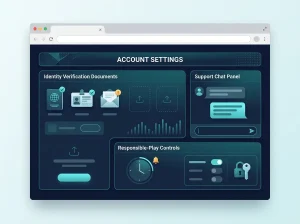
Winshark account verification, support and player controls
Winshark Notes A Winshark account connects three practical areas that are easy to treat separately:...